
Abstract
INTRODUCTION
Lung cancer continues to be a leading cause of morbidity and mortality.1,2 In addition to genetic, epigenetic, and stromal microenvironmental factors, the host microbiota, an integral part of the human body, significantly contributes to cancer development and progression.3Staphylococcus aureus (S. aureus), a Gram-positive bacterium, is known to cause DNA damage through its toxins and may promote carcinogenesis and metastasis in various cancer types, including lung cancer.4,5 The aim of our study was to establish a S. aureus infection model and investigate its molecular and cellular effects on lung cancer and normal bronchial epithelial cells.
MATERIAL AND METHODS
To establish an intracellular infection model, A549 lung cancer and BEAS-2B bronchial epithelial cell lines were infected with S. aureus at infection ratios of 1:25, 1:50, and 1:100 for 2 hours and treated with gentamicin for 2-4 hours to eliminate extracellular bacteria. Intracellular infection was visualized by Giemsa staining. Intracellular S. aureus load was determined by CFU analysis, and the infection index was calculated. The effect of S. aureus infection on cell cycle and cell death was analyzed using flow cytometry. Wound closure assay was performed to assess metastatic potential. Expression levels of key genes involved in cancer mechanisms were examined using reverse transcription quantitative polymerase chain reaction (RT-qPCR).
RESULTS
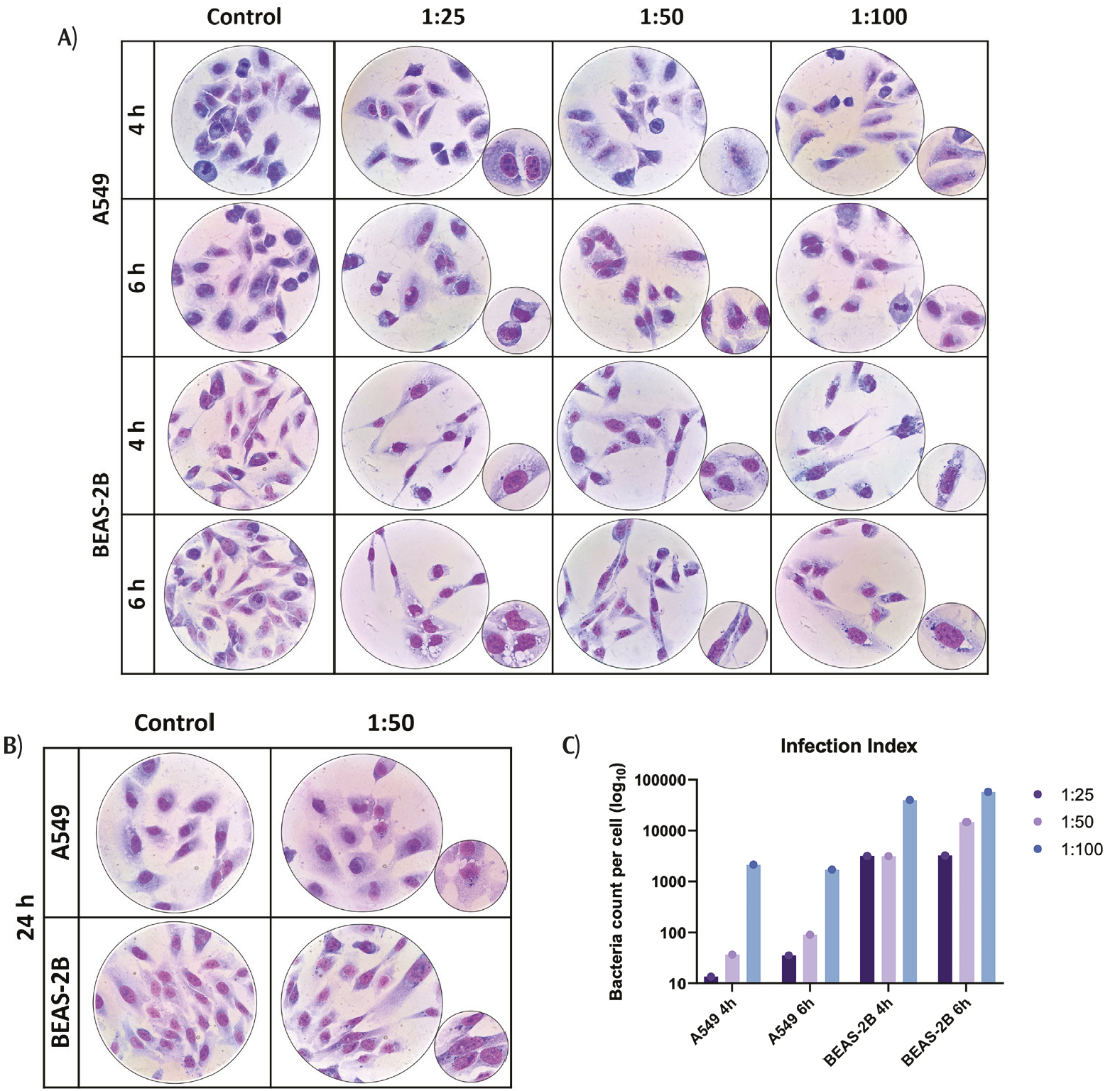
Intracellular S. aureus colonies were demonstrated in A549 and BEAS-2B cell lines at ratios of 1:25, 1:50, and 1:100 (Figure 1A, B). BEAS-2B cells were observed to be more infected than A549 cells (Figure 1C). According to the migration assay results, A549 cells infected with S. aureus showed a significant increase in migration capacity compared to the control group. This finding suggests that S. aureus infection increases cell migration in A549 cells. Cell cycle analysis revealed that infected A549 cells accumulated, particularly in the G2 phase, 24 h after infection. These results suggest that S. aureus infection differentially affects these two cell lines. Furthermore, RT-qPCR analysis revealed changes in the expression levels of genes involved in important cellular processes.
CONCLUSION
This study demonstrates that S. aureus infection induces cell-type-specific responses in lung epithelial cells. BEAS-2B cells were more susceptible to colonization, while A549 cells exhibited increased migration and G2/M phase arrest, along with changes in gene expression associated with key cellular pathways. These findings suggest that S. aureus may contribute to pathological processes such as chronic infection or tumor progression at the cellular level.
Keywords: Cell culture, lung cancer, infection, Staphylococcus aureus
Footnotes
ACKNOWLEDGEMENTS: This study was supported by Ege University Scientific Research Projects Coordination Unit with project number TS-KBP-2024-31870.
References
Sung H, Ferlay J, Siegel RL, et al. Global Cancer Statistics 2020: GLOBOCAN Estimates of Incidence and Mortality Worldwide for 36 Cancers in 185 Countries. CA Cancer J Clin. 2021;71(3):209-249.
Herbst RS, Morgensztern D, Boshoff C. The biology and management of non-small cell lung cancer. Nature. 2018;553(7689):446-454.
Fu A, Yao B, Dong T, et al. Tumor-resident intracellular microbiota promotes metastatic colonization in breast cancer. Cell. 2022;185(8):1356-1372.
Deplanche M, Mouhali N, Nguyen MT, et al. Staphylococcus aureus induces DNA damage in host cell. Sci Rep. 2019;9(1):7694.
Wei Y, Sandhu E, Yang X, Yang J, Ren Y, Gao X. Bidirectional functional effects of Staphylococcus on carcinogenesis. Microorganisms. 2022;10(12):2353.